Does your tile roof need new tile or just new underlayment?
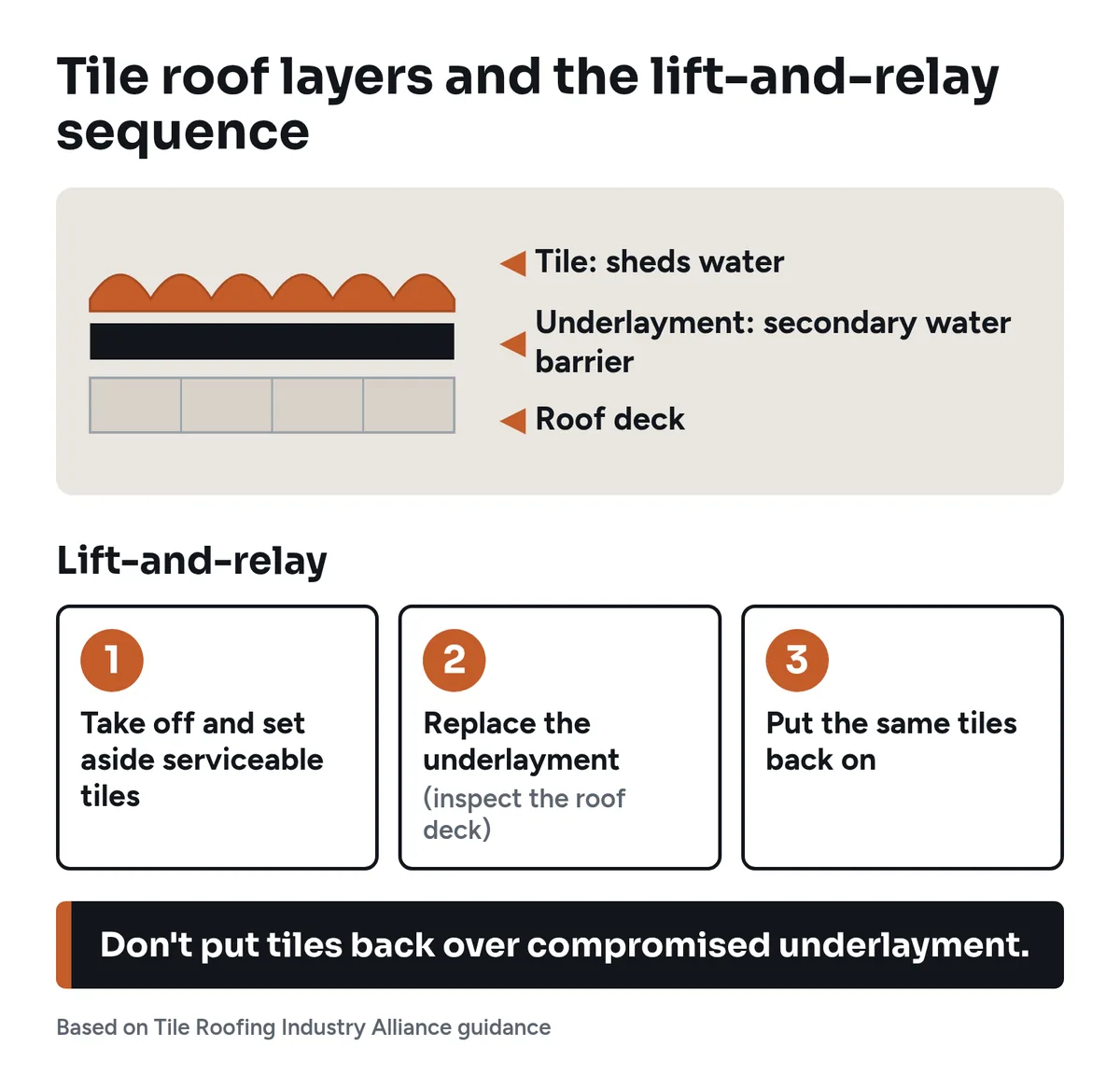
If your Fountain Hills tile roof is old or leaking, you may not automatically need a whole new set of tiles. One common path is a lift-and-relay: the existing tiles are taken off and set aside, the waterproofing layer underneath is replaced, and the same serviceable tiles are put back on. People also call this a re-felt or an underlayment replacement with tile reuse.
Whether the tiles can be reused depends on the condition of the tiles, the underlayment, and the roof deck.
What lift-and-relay means
In a lift-and-relay, tiles that are still in good enough shape are removed, stored, and put back after new underlayment is installed. The look of the roof can stay the same if those tiles survive removal and there's a way to replace any that break.
That is not the same as the "Harvest and Repair" method described in Tile Roofing Industry Alliance Technical Brief #2022-001. Harvest and Repair means moving tiles from an inconspicuous part of the roof, such as a side that doesn't face the street, to patch a visible damaged area, then filling the harvested spots with similar tiles. A lift-and-relay takes tiles off so the underlayment can be replaced, then puts those same serviceable tiles back.
Tile sheds water. The underlayment is the secondary water barrier. In a Tile Roofing Industry Alliance expert article published by Eagle Roofing on May 24, 2018, TRI President and Technical Director Rick Olson called underlayment "the secondary barrier for water shedding." The Tile Roofing Industry Alliance also describes the underlayment as a secondary water barrier in most cases.
According to a Tile Roofing Industry Alliance expert article published by Eagle Roofing, tile can outlast the house, but the long-term performance of the secondary barrier determines the life cycle of the roofing assembly.
The Tile Roofing Industry Alliance says a typical tile roof system is made of thousands of individual tiles, which may be safely removed and replaced without impacting the integrity of the roof system. New or harvested roof tiles should not be installed over compromised underlayment, regardless of the age of the roof system.
Why tile and underlayment can age differently
In Fountain Hills, tile roofs face strong sun, heat, and monsoon wetting. Those conditions can wear on the waterproofing layer even when the tiles still look solid.
TRI Technical Brief #2022-001 recommends that a qualified contractor inspect the underlayment before a tile roof repair, and that tiles should not go back over compromised underlayment, regardless of the roof's age.
The only way to know what is true for your roof is to look at the actual layers.
When underlayment replacement with tile reuse is the usual conversation
Lift-and-relay usually enters the conversation when:
- the tiles generally look and sound solid
- matching pieces exist for any tiles that break during removal
- leaks point more to aged waterproofing than to widespread tile failure
- you want to keep the current look
Those are starting points for a conversation, not a finding about your roof. An inspection still has to show that the tiles can come off and go back on, and that the underlayment beneath them needs to be replaced.
If you want more information about a full reroof instead, see the roof replacement page.
When new tile enters the conversation
New tile, meaning a full tile replacement, usually enters the conversation when:
- many tiles are cracked, spalled, or brittle
- the tiles are unlikely to survive being taken off
- you want a different profile or color
- tiles are missing and matching stock isn't available
Problems with the roof deck or the structure mean the deck should be evaluated and repaired as needed. They do not, by themselves, mean otherwise reusable tile has to be replaced. The Tile Roofing Industry Alliance recommends having a trained professional evaluate the underlayment and the roof decking when considering repair or replacement. Tiles may still be removed and put back over a repaired deck and sound underlayment.
A few broken tiles can also be a repair question rather than a whole-roof decision. The larger choice is still whether to reuse the current tiles over new underlayment, or replace the tiles too. Localized repair versus a whole-roof relay is a separate judgment for an inspection to inform.
See the roof repair page if you are looking at a smaller repair.
Other questions that come up
Which underlayment product to use is a separate topic.
The Town accepts building permit applications online only, through T.O.P.P.S., the Town's Online Permitting and Planning System. Building Safety can be reached at 480-816-5123 or 480-816-5177. The Town's Building Permit Forms and Checklists page has the permit forms and checklists. Accurate as of November 9, 2026.
What a useful inspection should show you
Ask the inspection to answer these questions:
- Can these tiles be removed and reused?
- Is the underlayment, the secondary water barrier, still sound? If it is compromised, tiles should not be put back over it.
- Does the roof deck need repair? A deck issue alone is not a reason to discard reusable tile.
- What is the condition of the flashings and valleys?
The Tile Roofing Industry Alliance recommends checking that the underlayment is in good shape before tiles go back on, and replacing the underlayment when the tiles are already off for a reroof.
You can read about a roof inspection if you want more information about that visit.
Accurate as of November 9, 2026.
If you want help understanding which path fits your tile roof, contact us for a quote or contact us for more information.